November 5, 2026
Rising Energy Bills and a Roof That Can’t Take Solar? There Is a Way Forward
How lightweight solar and zero upfront funding are helping businesses cut energy costs, build resilience and stay ahead of net zero deadlines

If you own or manage a commercial building, you will probably recognise the feeling.
Your energy bill keeps climbing. Someone suggests solar, and then your surveyor tells you the roof can’t take the weight. Even if it could, the upfront cost would land squarely on a budget that is already stretched.
It is a frustrating place to be, and you are far from alone. The good news is that both of those barriers, the structural one and the financial one, now have practical answers.
Why Are Business Energy Costs Still So Unpredictable?
Electricity is no longer a background overhead. For warehouses, logistics hubs, manufacturers, food producers and sports venues, it is one of the biggest and least predictable lines on the balance sheet.
Wholesale prices remain volatile, and grid costs and network charges continue to shape what businesses pay. Many owners are discovering that the old approach of buying power from the grid and hoping for the best is a real financial risk.
Generating your own electricity on site changes that. Every kilowatt hour produced on your roof is one you don’t have to buy, which makes solar one of the few tools that can both reduce costs and add stability to your forecasting.
Energy Security and Resilience: Why They Now Matter to Every Building Owner
Energy security used to sound like a government concern. It is now a boardroom one.
Grid constraints, delayed connections, price shocks and supply disruption have made businesses far more aware of how dependent they are on external power. Onsite generation reduces that dependence. Paired with battery storage, it can help sites keep operating and smooth out their power demand. Surplus energy can even be traded between buildings through a Virtual Power Plant.
Resilience is not just about avoiding the worst case. It is about having more control over your own energy future.
Net Zero Targets: What Building Owners Need to Keep in Mind
The direction of travel on decarbonisation is clear, and the deadlines are closer than they feel.
- 2030: The UK Government’s Clean Power 2030 mission aims for a clean electricity system by the end of this decade, and many large corporates have set their own 2030 interim targets.
- 2035: The UK has committed to a deep cut in emissions by 2035, on the path to net zero.
- 2050: Net zero by 2050 is written into UK law through the Climate Change Act.
- Along the way: Energy efficiency requirements for commercial buildings are expected to tighten, and reporting duties such as SECR already apply to many larger businesses.
Alongside regulation sits commercial pressure. Major retailers, brands, investors and public sector buyers increasingly ask suppliers for credible carbon reduction plans, and those questions are already appearing in tenders and procurement frameworks.
Onsite renewable generation is one of the most visible and measurable steps a building owner can take. The challenge has always been getting it onto the roof.
My Roof Can’t Take the Weight of Solar Panels. What Are My Options?
This is the question we hear most often.
Many commercial and industrial buildings, including warehouses, distribution centres, airports, stadiums and agricultural sheds, were never designed to carry the load of conventional solar. Traditional panels are heavy, and ballasted systems add even more weight. Strengthening the structure can cost so much that the project stops making sense, which is why countless buildings have been written off as unsuitable.
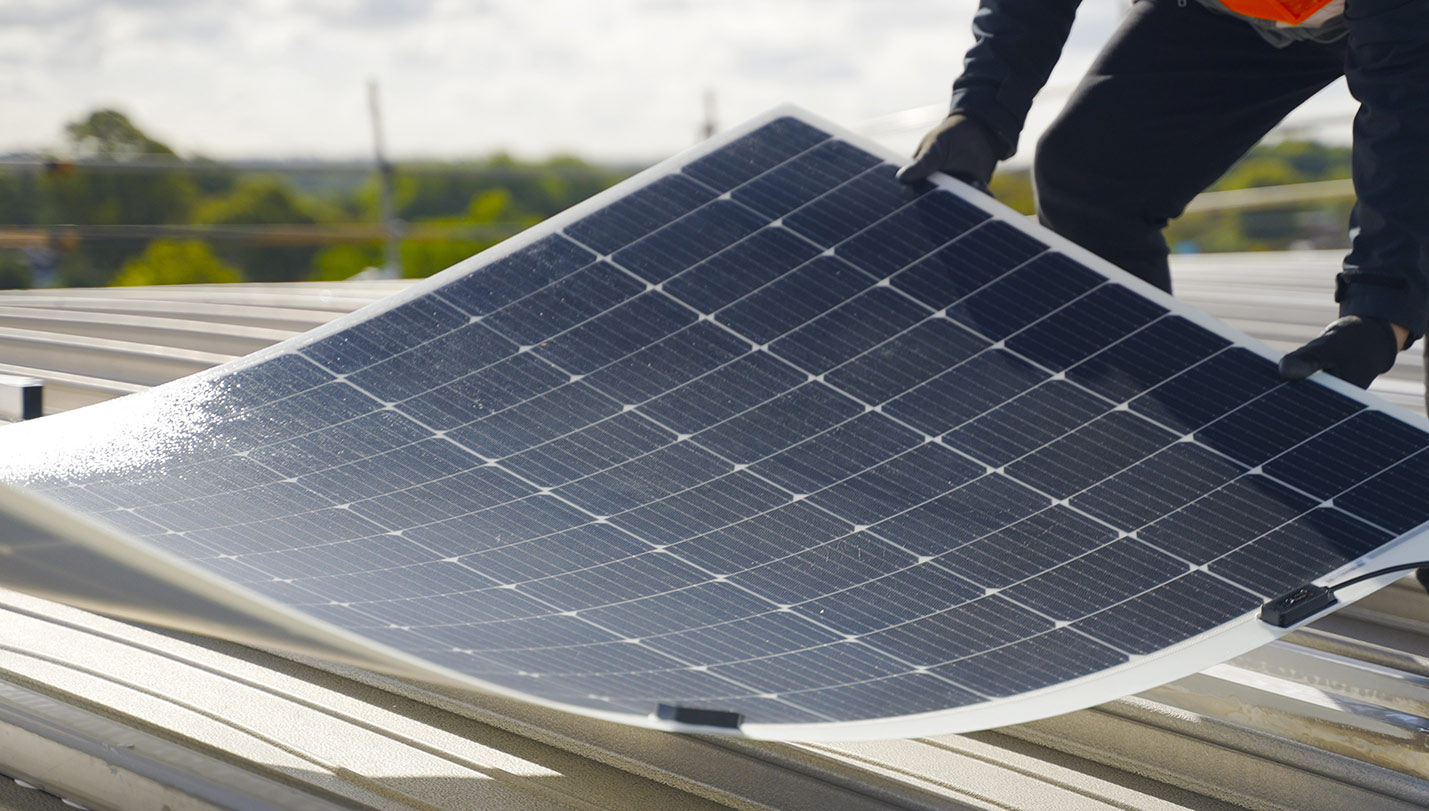
Lightweight solar changes that. Our panels are flexible, only around 2mm deep, and weigh just 1.8 to 4.0 kg per square metre. That makes them suitable for buildings that cannot take conventional solar because of weight or fixing constraints, including curved and membrane roofs.
But a light panel is only half of the answer. Every roof is different, and getting the engineering design and fixing method right is what makes an installation safe and durable. Solivus takes care of the whole process, from survey and design through to installation, monitoring and maintenance.
Proof It Works: Our Case Studies
We have delivered lightweight solar on buildings that were told it couldn’t be done:
- Tesco Watford Extra Superstore: A membrane roof meant conventional panels were not an option.
- Farnborough Airport: A large lightweight installation at the UK’s largest business aviation airport.
- Northamptonshire County Cricket Club: A stadium roof that gave the club a way to knock its energy bills for six.
- Astute Electronics: A warehouse headquarters in Stevenage energised despite its weight limits.
Different buildings, different roofs, the same outcome: lower energy costs and a clear step towards net zero.
Can I Install Solar Without Paying Upfront?
For many businesses, capital expenditure is the real blocker. Even when the payback is strong, finding a large sum up front is hard when cash flow is under pressure and other projects are competing for budget.
Solivus offers everything from initial design through to ongoing maintenance and monitoring software as well as various funding options which means businesses can start reducing energy costs straight away without tying up capital. The benefit shows up in your running costs from day one rather than after a long wait.
So Where Do You Start?
If you recognise yourself in this article, the first step is simple.
- Find out if your roof is suitable. A high level survey will show whether lightweight solar is the right fit, or whether conventional panels, carports or batteries make more sense.
- Understand your energy profile. The more of the power you can use on site, the stronger the savings.
- Choose how to fund it. Whether you prefer to invest or to pay monthly with nothing upfront, there is a route to suit your cash flow.
The Bottom Line
Rising bills, tightening regulation, structural limits and tight budgets can make it feel as though solar is for someone else. It isn’t.
Lightweight solar opens up buildings that were previously shut out. Funding that needs no upfront payment removes the capex barrier. And with 2030 and 2050 targets getting closer, acting sooner rather than later puts you in control instead of leaving you to react.
If your roof has been ruled out before, it may be time to ask again.
Ready to find out what your building could do? Get in touch with the Solivus team or explore our commercial solar solutions.
Reading List
Related Articles


ACCREDITATIONS




Newsletter
Bring sunshine to your inbox
Join our community for a quarterly dose of positve news from the world of solar.
Thank you! Your submission has been received!